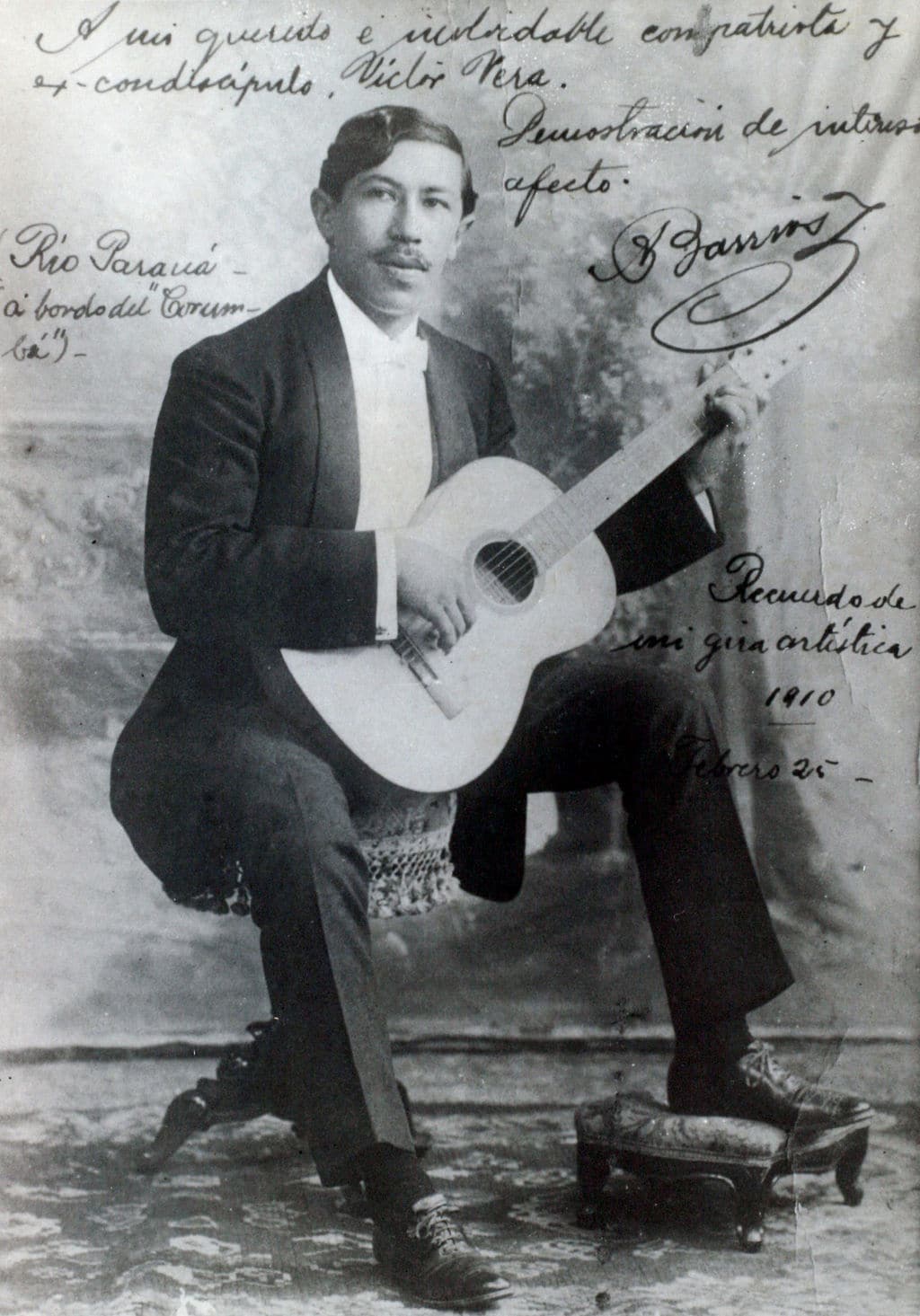
Agustín Pío Barrios
Agustín Pío Barrios 'Mangoré'
Legendary classical guitarist and composer, regarded as one of the greatest performers and composers for the instrument.
Biography
Agustín Pío Barrios was born on 5 May 1885 in San Juan Bautista de las Misiones, in southern Paraguay. Born into a family of Guaraní descent, Barrios showed extraordinary musical talent from an early age. He moved to Asunción during his adolescence and studied classical guitar with Gustavo Sosa Escalada and music theory with Italian violinist Nicolino Pellegrini. His prodigious abilities quickly became apparent, and by his late teens, he was already performing publicly and composing original works. Barrios adopted the artistic name "Nitsuga Mangoré"—"Nitsuga" being "Agustin" spelled backwards, and "Mangoré" honouring a legendary Guaraní chieftain. This choice reflected his deep pride in his Indigenous heritage and his desire to represent Paraguay's unique bicultural identity through his music. Barrios revolutionised classical guitar technique and composition, creating innovations that expanded the instrument's expressive possibilities. He composed more than 300 works for classical guitar, blending European classical traditions with Latin American folk influences to create a distinctive style that was both technically demanding and emotionally profound. His compositions ranged from virtuosic showpieces to deeply lyrical works that showcased the guitar's capacity for subtle expression. Barrios was also a phenomenal performer, often improvising during concerts and dazzling audiences with his technical mastery. He performed prolifically throughout Latin America, giving concerts in 28 different countries and building a reputation as one of the greatest guitarists of his generation. His 1921 composition "La Catedral," inspired by Johann Sebastian Bach and widely considered a masterpiece of the classical guitar repertoire, remains one of the most performed and recorded guitar works in the world. Despite his extraordinary talents, Barrios struggled for recognition during his lifetime, particularly from European classical music establishments that viewed Latin American composers as peripheral to the "serious" classical tradition. He spent much of his career touring Latin America, performing in cities large and small, often in difficult circumstances. His recordings, made on primitive equipment in the 1920s and 1930s, captured only a fraction of his artistry but demonstrated his remarkable technical command and interpretive depth. Barrios continued performing and composing throughout his life, though financial security always eluded him. He died on 7 August 1944 in San Salvador, El Salvador, far from his Paraguayan homeland, relatively unknown outside Latin America. In the decades following his death, Barrios's reputation underwent a dramatic transformation. As classical guitarists discovered his compositions and recordings, they recognised him as one of the most important guitar composers of the 20th century. His works entered the standard repertoire, performed and recorded by the world's leading guitarists. Today, Barrios is celebrated as a pioneer who elevated the classical guitar to new heights and proved that Latin American composers could create works of profound artistic significance. His appearance on the 50,000 Guaraníes banknote represents a watershed moment in Paraguayan cultural history—the first time the nation honoured an artist rather than a political or military figure on its currency. This choice powerfully declares that Paraguay values cultural contributions as much as political achievements, and that a Guaraní guitarist who brought beauty to the world deserves recognition alongside generals and presidents. Barrios's music continues to inspire guitarists worldwide, and his legacy as both a virtuoso performer and a composer of genius ensures that Paraguay's contribution to world culture through music will never be forgotten.
Historical Significance
Barrios elevated the classical guitar to new heights and proved that Latin American composers could create works of profound artistic significance. His appearance on currency represents Paraguay valuing cultural contributions as much as political achievements.
Featured on Banknotes
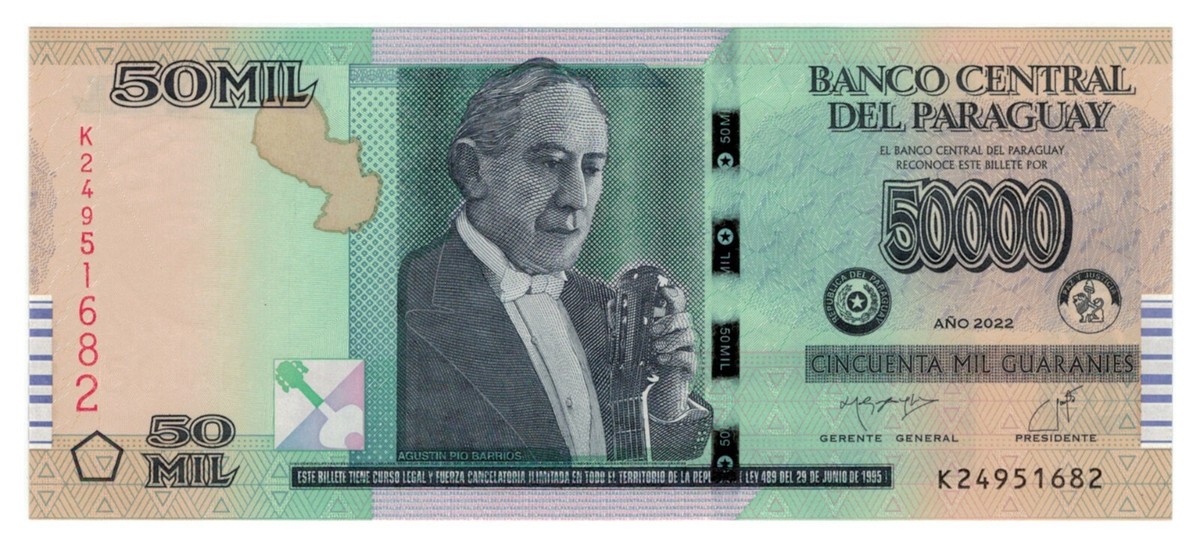
Honours Agustín Pío Barrios 'Mangoré', virtuoso classical guitarist and composer.